
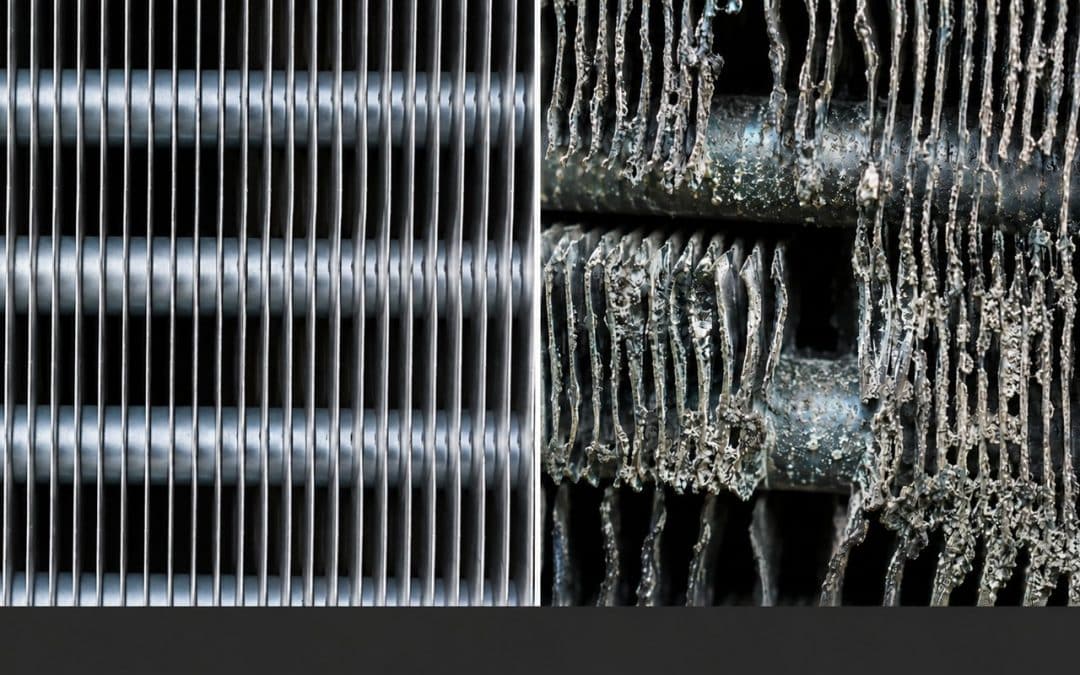
If you live near the beach and wonder why your AC rusts so fast near the ocean, the answer has a name most homeowners have never heard: fin rot. It is not a manufacturing defect. It is not bad luck. It is a specific type of corrosion that attacks the aluminum fins on your outdoor condenser unit, and in Jacksonville’s coastal climate, it happens faster than almost anywhere else in the country.
This post explains exactly what fin rot is, how it destroys your system from the outside in, and what you can do right now to slow it down before the damage becomes a replacement conversation.
What Is Fin Rot on an AC Unit?
Your outdoor AC condenser is built with dozens of thin aluminum fins wrapped around copper tubing. Those fins are the part of your system that releases heat into the outside air. Without them working properly, your AC cannot cool your home efficiently.
Fin rot happens when salt particles from ocean air settle on those aluminum fins and stay there. Salt is hygroscopic. It pulls moisture from the air and holds it against the metal surface. That constant moisture creates a chemical reaction between the aluminum fins and the copper tubing they sit against. Because aluminum and copper are two different metals in contact with a salty, conductive liquid, they form what engineers call a galvanic couple. The aluminum acts as the sacrificial metal, corroding faster to protect the copper. Over time, the fins pit, thin, and eventually crumble. According to Modine Coatings, a leading manufacturer of protective coil treatments, coastal salt air is the single biggest factor in coil corrosion environments worldwide.
Why Jacksonville Beach Homes See It Worse Than Most
Jacksonville sits at the intersection of two corrosion drivers: Atlantic Ocean salt air and year-round high humidity. Most coastal cities get a seasonal break when temperatures drop and humidity falls. Jacksonville does not. Your AC runs nearly every month of the year, and the outdoor unit is exposed to salt-laden air constantly, not just in summer.
On top of that, Jacksonville’s prevailing winds push ocean air inland more consistently than many other Florida cities. Homes in Jacksonville Beach, Neptune Beach, and Atlantic Beach sit directly in that wind path. Even homes in Ponte Vedra and parts of St. Johns see meaningful salt exposure on days with strong easterly winds off the Atlantic.
The Chain Reaction Happening Inside Your Outdoor Unit
Fin rot does not announce itself. It builds quietly over months and years while your system keeps running, just less and less efficiently. Here is the chain reaction it sets off:
- Heat transfer drops. As fins corrode and thin, your condenser loses its ability to push heat out of your home. Your system has to run longer to hit the same temperature.
- Energy bills climb. Longer run times mean higher electricity costs. Many coastal homeowners chalk this up to summer heat without realizing their corroded coils are the real culprit.
- Refrigerant leaks develop. As corrosion eats through the fins and reaches the copper tubing underneath, pinhole leaks form. These are expensive to locate and even more expensive to repair.
- The compressor takes the hit. When coils cannot transfer heat properly, the compressor works harder to compensate. The compressor is the most expensive component in your system. When it goes, the repair bill often makes replacement the smarter call.
- Electrical connections corrode. Salt and moisture do not stop at the fins. They work into the electrical components of the outdoor unit, causing erratic operation and unexpected shutdowns.
A standard AC unit should last 12 to 15 years in inland Florida. A coastal unit hit by fin rot without any protective measures can fail in five to seven years. That is a significant financial difference, and it is entirely preventable with the right maintenance approach.
How to Tell If Fin Rot Has Already Started on Your Unit
You do not need a technician to spot the early signs. Walk out to your outdoor unit and look closely at the fins, the thin metal slats running vertically around the outside of the condenser cabinet. Here is what to look for:
- White or chalky powder on the fins. This is aluminum oxide, the direct byproduct of salt corrosion eating through the metal.
- Fins that look thin, ragged, or crumbling at the edges. Healthy fins are uniform and flat. Corroded fins start to look irregular and fragile.
- Rust streaks on the cabinet or base pan. Surface rust on the housing is a sign that moisture and salt have been sitting on your unit long enough to work through the paint.
- Your system running longer than it used to. If your AC used to reach your set temperature in 20 minutes and now it takes 35, degraded heat transfer from corroded fins is a likely cause.
- Higher energy bills with no change in usage. Fin rot forces your system to work harder. That shows up on your JEA bill before it shows up as a breakdown.
If your unit is under ten years old and you are seeing two or more of these signs, schedule a maintenance inspection before the damage goes deeper. The Florida Air Flow maintenance plan includes a full coastal inspection specifically designed to catch corrosion at the stage where it can still be addressed, not after it has reached the compressor.
How to Stop the Damage Before It Reaches Your Compressor
The good news is that fin rot is not inevitable. Coastal homeowners who stay ahead of it keep their systems running well past the average lifespan. Here is what actually works:
- Rinse your outdoor unit monthly with a garden hose. A gentle freshwater rinse washes salt deposits off the fins before they have time to start the corrosion process. Never use a pressure washer. It bends the fins and makes things worse. Ten minutes once a month makes a real difference.
- Get a protective coil coating applied. Anti-corrosion coatings create a barrier between the aluminum fins and the salt air. Some are factory-applied on newer units. Others can be applied in the field by a technician during a maintenance visit. If you live within three miles of the coast and your current unit does not have a coating, ask about adding one.
- Schedule maintenance twice a year, not once. The standard once-a-year tune-up is built for inland systems. Coastal homes need a spring visit before peak AC season and a fall visit to assess any salt damage that built up over the summer.
- Ask about coastal-rated equipment when you replace. When your current unit reaches the end of its life, the replacement conversation should include coil coatings, corrosion-resistant hardware, and unit placement away from direct ocean wind. These are not upgrades. They are baseline requirements for Jacksonville Beach homes.
- Change your filter every 30 days. Salt air increases the particulate load moving through your system. A dirty filter makes your unit work harder and slows airflow across the coils, which speeds up moisture buildup and corrosion.
Don’t Wait Until Your Unit Tells You It’s Too Late
Fin rot is slow, silent, and expensive when it goes unaddressed. Most Jacksonville Beach homeowners find out about it when a technician tells them their coils are too far gone to clean and the refrigerant leak is not worth chasing on a corroded unit. At that point, the choice is an expensive repair or a full replacement. Neither had to happen that soon.
The homeowners who avoid that conversation are the ones who treat maintenance as a year-round habit, not a one-time checkbox. If your outdoor unit has not been inspected with a coastal eye in the last year, now is the right time.
Contact Florida Air Flow today to schedule a coastal AC inspection. We serve Jacksonville Beach, Atlantic Beach, Neptune Beach, Ponte Vedra, and the surrounding communities. We will tell you honestly what stage your unit is at, whether a cleaning and coating can extend its life, and what to plan for if replacement is on the horizon.