
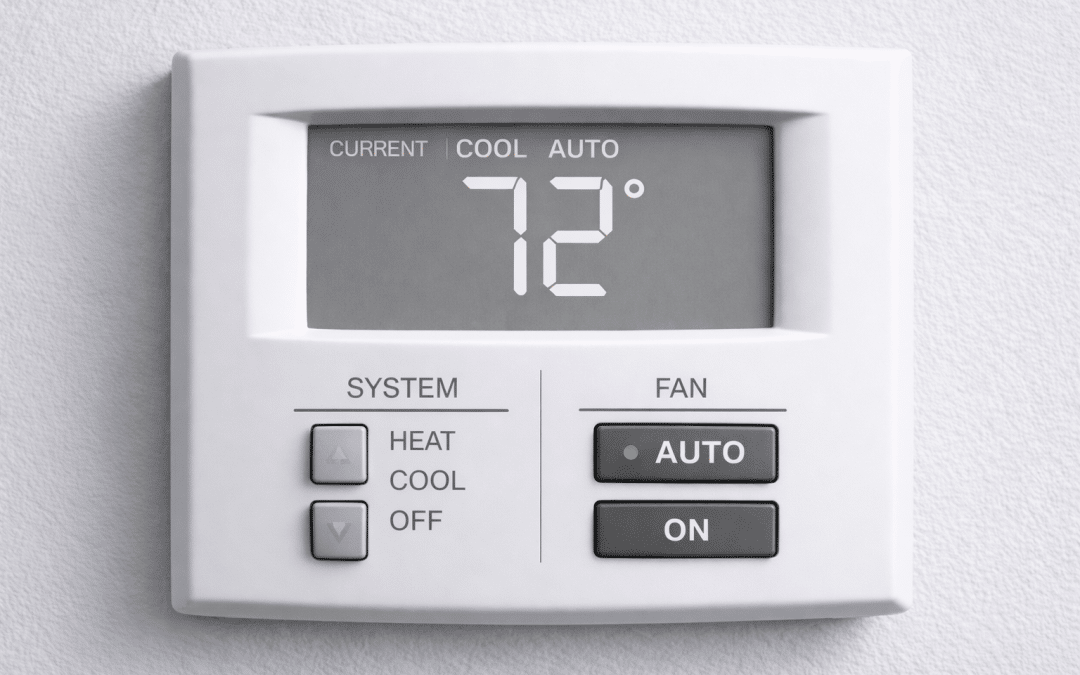
AUTO vs ON thermostat fan settings in Jacksonville make a bigger difference than most homeowners realize. When you set your thermostat fan to AUTO, the fan only runs when your system is actively heating or cooling. When you set it to ON, the fan runs continuously 24/7, even when your AC isn’t cooling your home. For most Jacksonville homeowners, AUTO saves 15-30% on energy bills compared to ON, which translates to $200-400 in annual savings.
Let’s explore when to use each setting, why AUTO typically saves you money in Florida’s climate, and the rare situations where ON makes sense.
Understanding AUTO vs ON Thermostat Fan Settings
Your thermostat controls two separate functions. The temperature setting tells your system when to heat or cool. The fan setting controls when your blower motor runs to circulate air through your home.
AUTO means the fan turns on automatically only when your AC or heater is running. Once your home reaches the set temperature, both the compressor and the fan shut off completely. The fan stays off until the temperature changes enough to trigger another cooling or heating cycle.
ON means the fan runs constantly, regardless of whether your system is heating or cooling. Your compressor still cycles on and off based on temperature, but the fan never stops moving air through your ductwork. This continuous operation is where the energy waste happens.
Why AUTO Saves You Money in Jacksonville
Jacksonville’s year-round cooling demands mean your AC already runs more than systems in most other climates. Setting your fan to ON adds unnecessary runtime that drives up your electric bill significantly. Your fan motor typically uses 400-600 watts while running. Running continuously, that’s 9,600-14,400 watt-hours per day, or about 290-432 kilowatt-hours monthly.
At Jacksonville’s average electricity rate of $0.13 per kWh, continuous fan operation costs an extra $38-56 per month. Over a year, that’s $456-672 in wasted electricity just from your fan setting. Moreover, this calculation assumes normal efficiency. Older or poorly maintained fans use even more power.
AUTO mode eliminates this waste. The fan only runs when necessary, typically 8-12 hours daily in summer and 4-6 hours in winter. This reduced runtime directly translates to lower energy bills. Additionally, less runtime means less wear on your fan motor, potentially extending its lifespan by several years.
Jacksonville’s Humidity Problem with ON Settings
Florida’s humidity makes the ON setting particularly problematic. When your AC cools your home, moisture from the air condenses on the cold evaporator coils. This dehumidification is just as important as temperature control for comfort in Jacksonville’s climate.
The condensed moisture needs time to drain out of your system through the condensate line. When your fan is set to AUTO, it stops after each cooling cycle, giving water time to drip into the drain pan and exit your home. This proper drainage is essential for humidity control.
When your fan is set to ON, it keeps blowing air over those wet coils even after the AC stops cooling. This continuous airflow picks up moisture droplets and blows them back into your home. Consequently, your AC removes moisture during the cooling cycle, then your fan immediately returns that moisture to your air.
This moisture recycling forces your AC to work harder on the next cycle. Your system has to remove not just the naturally occurring humidity, but also the moisture it just put back. Therefore, ON mode in Jacksonville doesn’t just waste electricity on fan operation. It also makes your compressor run longer and more frequently.
How Much AUTO Really Saves Jacksonville Homeowners
Real-world testing shows significant savings from AUTO mode in Florida climates. A typical 3-ton AC system in Jacksonville running with the fan on AUTO uses about 2,500-3,000 kWh annually. The same system with the fan set to ON uses 3,500-4,200 kWh annually.
That 1,000-1,200 kWh difference equals $130-156 in annual savings at current Jacksonville electricity rates. For a larger 4-ton system, savings increase to $170-200 yearly. These figures only account for direct fan operation costs and don’t include the additional AC runtime needed to re-dehumidify air.
When you factor in the extra AC cycles needed to combat moisture problems, total savings from AUTO mode typically reach $200-300 annually for average homes. Larger homes or homes with older, less efficient equipment see even greater savings. Furthermore, reduced equipment runtime means fewer repairs and longer system life.
When You Should Use ON Instead of AUTO
Despite the costs, ON mode makes sense in specific situations. If you’re experiencing severe hot spots in certain rooms, running the fan continuously helps distribute air more evenly. This works better as a temporary solution while you identify the root cause rather than a permanent setting.
After cooking or if someone smokes inside, ON mode helps clear odors faster. Similarly, if you’ve just painted or used cleaning chemicals, running the fan continuously for a few hours helps ventilate your home. Just remember to switch back to AUTO afterward.
Homes with advanced air purification systems sometimes benefit from ON mode. If you’ve invested in a whole-home UV light system or high-efficiency media filter for allergies, continuous air circulation means more passes through your filtration. However, you’ll need to change filters more frequently and accept higher energy costs.
Some Jacksonville homes have ductwork problems that create temperature imbalances. While ON mode can temporarily mask these issues, it’s better to have professional air duct services address the underlying problem. Properly sealed and balanced ductwork with AUTO mode outperforms leaky ducts with ON mode.
The Filter Replacement Problem with ON Mode
Continuous fan operation means air constantly passes through your filter. This increased airflow traps more particles, causing filters to clog faster. Homes using ON mode typically need filter changes every 20-30 days instead of the standard 60-90 days.
More frequent filter changes increase your maintenance costs. Standard 1-inch filters cost $5-15 each, so monthly changes add $60-180 annually to your expenses. High-efficiency filters cost even more, potentially adding $200-300 yearly just for increased filter replacement.
Clogged filters create additional problems beyond the replacement cost. A dirty filter restricts airflow, forcing your fan motor to work harder. This increased strain uses more electricity and generates more heat, potentially shortening motor life. Additionally, restricted airflow reduces system efficiency, making your AC work harder to cool your home.
Impact on Your HVAC System’s Lifespan
Continuous operation logically seems like it would wear out equipment faster. However, the relationship between fan settings and equipment life is more complex than simple runtime calculations suggest. Motors experience the most stress during startup when they draw maximum current.
AUTO mode creates more start-stop cycles, which means more high-stress startups. ON mode eliminates these stress cycles but runs the motor continuously. According to the U.S. Department of Energy, modern HVAC equipment is designed to handle the cycling from AUTO mode efficiently.
The real lifespan factor is total operating hours. A fan running ON accumulates 8,760 hours annually. The same fan on AUTO typically runs 3,000-4,000 hours yearly in Jacksonville’s climate. That’s more than double the operating hours, which generally translates to earlier component failure.
Fan motors typically last 15-20 years on AUTO mode in Jacksonville. The same motors on ON mode often fail after 10-12 years. Replacement costs $300-800 depending on your system. Therefore, ON mode’s shorter equipment life adds another hidden cost beyond the energy waste.
Smart Thermostats and Advanced Fan Controls
Modern smart thermostats offer fan settings beyond simple AUTO and ON. Many include a “circulate” mode that runs the fan for a set number of minutes each hour, even when the system isn’t heating or cooling. This provides some air circulation benefits without the constant operation of ON mode.
Typical circulate settings run the fan 15-20 minutes per hour. This adds about 6 hours of fan runtime daily, compared to 24 hours with ON. The result is better air mixing than pure AUTO mode but much lower costs than ON mode. Additionally, circulate mode still allows proper dehumidification between fan cycles.
Some advanced systems automatically adjust fan speed based on conditions. Variable-speed fans can run at lower speeds for air circulation, then ramp up when the AC turns on. These systems provide the circulation benefits of ON mode while using 30-50% less energy than single-speed fans.
If you’re considering upgrading your thermostat or entire system, look for these advanced fan control features. They represent the best compromise between air circulation, comfort, and energy efficiency for Jacksonville homes.
Common Myths About Thermostat Fan Settings
Many homeowners believe keeping the fan on improves air filtration significantly. While it does pass more air through your filter, the benefits rarely justify the costs. Standard filters only capture particles while air is moving, so longer runtime does mean more filtration. However, the increased filter replacement costs and energy waste usually outweigh the air quality improvements.
Another myth claims AUTO mode causes temperature swings. In reality, your thermostat controls cycling based on temperature, not fan setting. If you’re experiencing uncomfortable temperature variations, the problem lies with thermostat placement, system sizing, or ductwork issues, not your fan setting.
Some people think ON mode prevents mold by keeping air moving. In fact, the opposite is true in Jacksonville’s humidity. ON mode blows moisture back into your home, creating the damp conditions mold needs to grow. AUTO mode, by allowing proper dehumidification, helps prevent mold growth.
How to Test Which Setting Works Best for You
Despite the general recommendation for AUTO, testing both settings in your specific home provides concrete data. Start by setting your fan to AUTO for a full billing cycle. Note your energy usage and comfort level. Pay attention to any hot spots, stuffiness, or humidity issues.
The following month, switch to ON and track the same metrics. Compare your electricity bills, considering weather differences between months. Jacksonville’s weather can vary significantly month to month, so try to compare similar temperature periods if possible.
Most homeowners discover AUTO saves $20-40 monthly with no comfort penalty. If you notice specific comfort issues with AUTO, address the underlying cause rather than masking it with ON mode. Common issues include duct leaks, inadequate insulation, or improper system sizing.
What Setting HVAC Professionals Recommend for Jacksonville
HVAC technicians almost universally recommend AUTO mode for Jacksonville homes. The energy savings, better humidity control, and longer equipment life make AUTO the clear winner for the vast majority of situations. The rare exceptions where ON makes sense are temporary, specific circumstances rather than everyday operation.
If you’re using ON mode to solve comfort problems, you’re treating symptoms instead of causes. Uneven temperatures, excess humidity, or poor air quality have specific solutions that don’t require wasting energy. Professional duct sealing, system balancing, or equipment upgrades address these issues properly.
Make Your Thermostat Settings Work for You
Understanding AUTO vs ON thermostat fan settings in Jacksonville helps you make informed decisions about your home comfort and energy costs. For most homeowners, AUTO mode provides the best balance of comfort, efficiency, and equipment life. The $200-400 in annual savings adds up significantly over your system’s lifetime.
If you’re experiencing comfort issues that tempt you to use ON mode, the real solution lies in identifying and fixing the underlying problem. Don’t let comfort issues or energy waste continue. Florida Air Flow specializes in optimizing HVAC performance for Jacksonville’s unique climate. Our certified technicians can diagnose comfort problems, seal ductwork, balance airflow, and ensure your system operates efficiently on AUTO mode.
Take control of your energy costs and home comfort today. Contact Florida Air Flow to schedule a comprehensive system evaluation. We’ll identify any issues preventing comfortable, efficient operation and provide honest solutions that save you money every month. Stop wasting hundreds of dollars annually on the wrong fan setting. Call us now for expert guidance you can trust.