
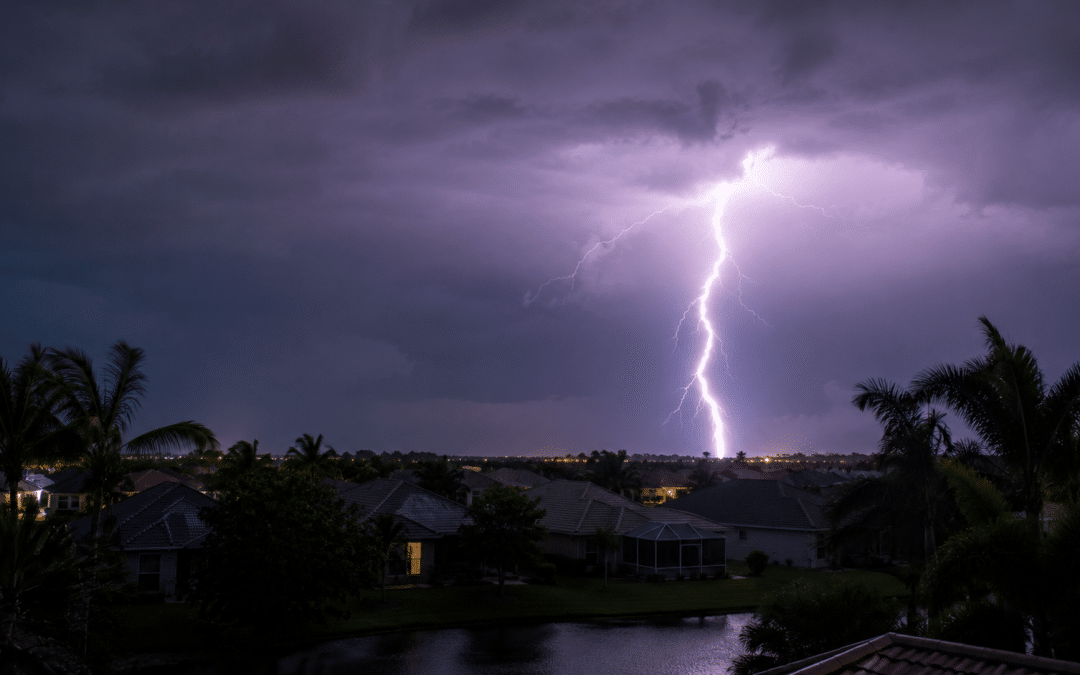
If you’ve watched a Jacksonville thunderstorm roll in and wondered, “can lightning damage my AC unit?” the answer is yes, and it happens more often than most homeowners realize. Florida sits at the top of the list for lightning activity in the entire country. The Jacksonville area gets some of the busiest summer storm days of any city in the state.
Direct strikes to your AC are rare. Nearby strikes that send a surge through your electrical system are far more common, and they cause most of the damage we see. The good news is that most of it is preventable, and if it already happened, an inspection can catch it before it turns into a compressor replacement.
How Can Lightning Damage My AC Unit?
Lightning damages your AC in two ways. It either hits your unit directly or strikes something nearby and pushes a power surge through your electrical system.
Direct strikes are rare, and they usually leave visible damage. Melted plastic. Blown wiring. Burn marks around the disconnect box on your outside wall. If you see any of that after a storm, don’t turn the system back on. Call for an inspection first.
Nearby strikes are far more common. When lightning hits a power line, a transformer, or a tall tree close to your home, it can send a voltage spike through the grid that reaches your AC in a fraction of a second. That spike is small enough to slip past standard breakers but strong enough to fry sensitive electronics inside the unit.
The parts that take the hit most often are:
- The capacitor (small, cheap, easy to replace)
- The contactor (relatively cheap and a common storm-season failure)
- The control board (moderate cost, very sensitive to surges)
- The compressor (the priciest part, sometimes damaged in slow motion over weeks)
This is why we tell every Jacksonville homeowner the same thing: turn your AC off at the breaker when a big storm is coming. If you missed our last piece on hurricane prep, here’s when to shut it down and how.
What Are the Signs My AC Was Struck by Lightning?
Some lightning damage is loud and obvious. Some hides for weeks. Here’s what to watch for after any big Jacksonville thunderstorm.
Immediate signs (within an hour of the storm):
- Your AC won’t turn on at all
- The unit hums but the fan doesn’t spin
- A burning or plastic smell coming from the outdoor unit or vents
- The breaker for your AC keeps tripping when you reset it
- Visible burn marks near the disconnect box
- The thermostat is blank or unresponsive
Delayed signs (days or weeks after):
- A slow drop in cooling performance
- Short cycling (the system turns on and off in quick bursts)
- Unusual buzzing from the outdoor unit
- Higher-than-normal power bills for the same cooling
- Random shutdowns when the weather is mild
That second group is the sneakiest. Small surges cause what techs sometimes call “electronic rust” inside the control board. The damage builds up over time. Your system limps along and works harder to do the same job, until a component finally gives out. When you notice your AC keep tripping the breaker weeks after a storm, that’s often the tail end of surge damage catching up.
What Should I Do Right After a Nearby Lightning Strike?
If a strike hit close to your home, take these steps in order:
- Shut off the AC at the thermostat.
- Walk to your electrical panel and flip the breaker for the outdoor unit.
- Wait 15 to 20 minutes for the grid to settle.
- Check your outdoor unit visually. Look for burn marks, melted wiring, or a burnt smell.
- If everything looks clean, restore power at the breaker and try the thermostat.
- If the system won’t start, hums without spinning, or smells wrong, shut it down and call for an inspection.
The 15 to 20 minute wait matters. JEA and other utility providers sometimes re-route power right after a strike, and a second surge can follow within minutes. Waiting protects your unit from a double hit.
Can Lightning Damage My AC Unit Without Hitting It Directly?
Yes, and this is the version we see most often in Jacksonville. When lightning strikes a power line, a nearby tree, or a transformer, the surge travels through the grid and can reach your home in milliseconds. Homes in Mandarin, Ortega, San Marco, and the beach communities see this pattern every summer.
You don’t need to be near the strike for damage. A bolt that hits a power pole a mile away can still push enough voltage through the system to damage your AC. This is why surge protection matters even when the storm feels far off.
How Do I Protect My AC From Lightning in Jacksonville?
The three best defenses stack together for full protection.
1. Shut it off before the storm. Turn the AC off at the thermostat and flip the breaker. This is the cheapest and most effective step you can take. It works for every kind of storm, not just hurricanes.
2. Install a whole-house surge protector. These sit at your main electrical panel and absorb voltage spikes before they reach your AC, appliances, or electronics. They typically run a few hundred dollars installed and last for years.
3. Add a dedicated AC surge protector. These mount at the outdoor unit and offer a second layer of protection. They cost far less than a full compressor replacement.
The federal government’s Ready.gov thunderstorm and lightning safety page has more on general storm prep. For AC-specific protection, our team handles diagnostic and repair services across Jacksonville, so if you’re not sure whether your setup is protecting the unit right, we can come out and check.
Does Homeowners Insurance Cover Lightning Damage to My AC Unit?
In most cases, yes. Standard homeowners policies in Florida usually cover sudden and accidental damage from lightning strikes, and that includes damage to your HVAC system. Your deductible applies, and you’ll need proof that the damage came from a specific storm.
To make the claim smoother:
- Take photos of your outdoor unit before storm season starts
- Note the date and time of the strike or storm
- Save any weather reports showing lightning in your area that day
- Call a licensed HVAC technician for a written diagnostic report
- Contact your insurance carrier before scheduling repairs
Policies vary, and older units may fall under wear-and-tear exclusions if the damage isn’t clearly storm-related. A written technician report is usually the piece that makes or breaks the claim.
Why 2026 Makes Lightning Damage More Expensive Than Before
Refrigerant prices roughly doubled this year, and new systems switched to R-454B. A compressor replacement that ran roughly $2,000 to $2,500 a couple years ago can now land closer to $3,000 to $4,000 in the ballpark. Capacitor and contactor repairs are still relatively affordable, but the parts most vulnerable to surge damage are also the ones that got pricier.
Every summer we see homeowners try to ignore the small warning signs. A short cycle here, a slow drop in cooling there. What starts as a small capacitor replacement can turn into a compressor replacement if the underlying surge damage keeps working through the system.
Get Your AC Checked After the Next Big Storm
If you had a close lightning strike this summer and you’re not sure your AC survived it, we’d rather come out and check than have you wonder for weeks. A short diagnostic visit catches the hidden damage that shows up too late for insurance to help.
Call Florida Air Flow Heating & Air at (904) 982-9731, or reach out through our contact page. We serve Jacksonville, Atlantic Beach, Neptune Beach, Jacksonville Beach, Ponte Vedra, Nocatee, Orange Park, St. Augustine, and every neighborhood in between. When your AC starts acting strange after a storm, we’re here to help you sort it out.