
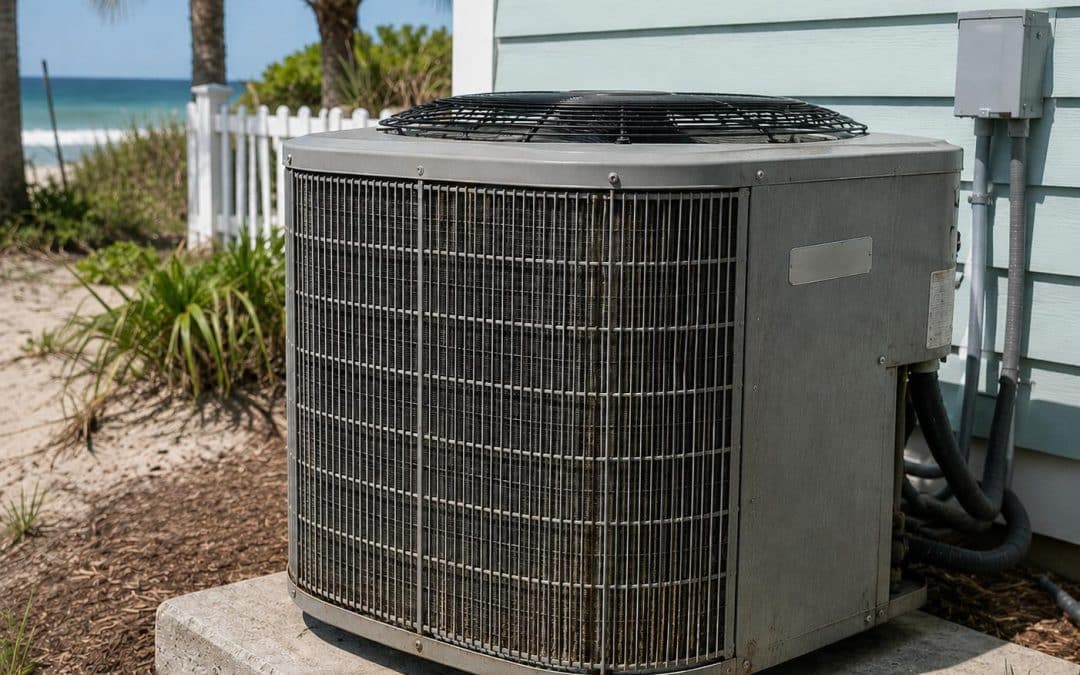
Knowing how to tell if your AC has salt damage is one of the most useful things a Jacksonville coastal homeowner can learn. Start with the basic question: Does salt air damage AC units in Jacksonville? Both salt corrosion and normal aging cause rust, reduced cooling, and higher energy bills. But they are not the same problem, and they do not call for the same response. Getting this wrong means either replacing a unit that had years left in it, or patching a salt-damaged system that is already too far gone to save.
This post walks you through the specific signs that point to salt damage over normal wear, what each one means for your system, and when to call in a professional for a closer look.
Why the Distinction Matters for Jacksonville Homeowners
A standard AC unit in inland Florida typically lasts 12 to 15 years. Normal wear is gradual and predictable. Parts fatigue over time, efficiency slowly drops, and the system gives you plenty of warning before it fails completely.
Salt damage does not work that way. It accelerates corrosion on specific components, often cutting years off a system’s life without any obvious signs until the damage is already deep. A unit in Jacksonville Beach can show significant salt corrosion in as little as three to five years if it has never been rinsed or coated. That same unit, maintained correctly, can run well past the ten-year mark. The difference between those two outcomes often comes down to catching the damage early and knowing what you are looking at.
Start Here: Check the Age of Your Unit
Before anything else, find out how old your outdoor unit is. The manufacture date is printed on a label on the side of the cabinet, usually as part of the serial number. Many manufacturers encode the year and week of production in the first four digits.
Use age as your first filter:
- Under 7 years old with visible corrosion: Almost certainly salt damage. A well-maintained unit this age should not show significant rust or fin deterioration from normal wear alone.
- 7 to 12 years old with corrosion: Could be either. Location is the key variable. A unit in Jacksonville Beach at this age with heavy corrosion points strongly to salt. A unit in Mandarin or Southside at the same age is more likely showing normal wear.
- Over 12 years old with corrosion: Normal wear becomes a more likely contributor, though salt may have accelerated the timeline significantly.
Age alone does not tell you everything. However, it narrows down the likely cause before you even look at the unit itself.
What Salt Damage Looks Like vs. Normal Wear
This is where most homeowners get confused. Both conditions cause rust and degradation, but the pattern, location, and texture of the damage tells a very different story.
The Fins
The aluminum fins running around the outside of your condenser are the clearest indicator. Run your finger gently along the edge of the fins and look closely at their condition.
- Salt damage: Fins appear chalky white or powdery, especially near the edges. The metal feels thin and fragile. In advanced cases, fins crumble when touched or look like they are dissolving at the tips. This white powder is aluminum oxide, a direct byproduct of salt corrosion eating through the metal.
- Normal wear: Fins may be bent or dirty, but the metal itself remains structurally solid. Bent fins from age or debris look physically deformed but not chemically degraded. They do not crumble.
The Cabinet and Base Pan
- Salt damage: Rust appears on the cabinet surface within the first few years of installation, often starting at seams, screws, and the base pan where moisture pools. The rust tends to spread in patterns consistent with water running down salt-coated surfaces.
- Normal wear: Surface rust on an older cabinet is common and does not necessarily indicate internal damage. A unit that is 12 or more years old with light cabinet rust is behaving as expected for its age and environment.
The Coils
You may need a flashlight for this one. Look through the fins at the copper tubing and the coil surface inside.
- Salt damage: Pitting, green or blue discoloration on copper tubing, and a rough or cratered surface on the coil. These are signs of galvanic corrosion working between the aluminum fins and copper tubes. According to research on coastal coil corrosion, unprotected aluminum fins in high-salt environments can begin pitting within two to three years of installation.
- Normal wear: Coils may be dirty or coated with grime, but the metal surface underneath remains relatively smooth when cleaned. Age-related coil issues tend to involve refrigerant leaks from mechanical stress rather than the pitting and cratering pattern that salt causes.
Performance Clues That Point to Salt Over Age
Sometimes you cannot see the damage clearly without removing panels. In those cases, how your system is behaving can point you in the right direction.
- Your unit is under ten years old and struggling to cool. A young system that runs constantly without reaching your set temperature is not behaving like a system with normal age-related wear. Degraded heat transfer from corroded fins is a far more likely explanation for a unit this age in a coastal Jacksonville home.
- Your energy bills have climbed steadily over the past two summers. Salt corrosion reduces heat transfer efficiency gradually. That pattern shows up as a slow, consistent rise in your JEA bill rather than a sudden spike, which is more typical of a mechanical failure.
- You are getting refrigerant leaks on a relatively new unit. Refrigerant leaks on a unit under eight years old almost always trace back to pinhole corrosion in the copper tubing rather than mechanical failure from age. If a technician has found and repaired a refrigerant leak and your system is under a decade old, ask specifically whether the leak was located at a corrosion pit.
- The system shuts down unexpectedly on hot days. Salt corroding electrical connections and control board components causes erratic behavior that looks random but is actually the result of compromised contacts. Age-related electrical failures tend to be more predictable and progressive.
When to Call a Professional for a Salt Damage Assessment
Some of these checks you can do yourself in ten minutes. Others require a trained eye and the right tools. Call for a professional inspection if any of the following apply:
- Your unit is under ten years old and showing two or more of the signs above
- You have had a refrigerant leak repaired in the past two years and live within five miles of the coast
- Your system is running longer than usual and your energy bills have risen without a change in usage
- You cannot remember the last time your outdoor unit was rinsed or inspected for coastal corrosion
A professional inspection goes beyond what you can see from the outside. A technician can check coil integrity, test electrical connections for salt-related degradation, and give you a realistic assessment of how much life your current unit has left. The Florida Air Flow AC repair team performs coastal-specific inspections for Jacksonville Beach, Atlantic Beach, Neptune Beach, and Ponte Vedra homeowners and can tell you whether you are dealing with salt damage, normal wear, or a combination of both.
Salt Damage Does Not Always Mean Replacement
Here is something most homeowners do not hear enough: catching salt damage early often means you can extend your unit’s life rather than replace it. A deep coil cleaning to remove existing salt deposits, combined with a protective coating applied by a technician, can add meaningful years to a system that still has solid mechanical components. The time to have that conversation is before the compressor is involved, not after.
If your unit is already past the point where cleaning and coating make sense, that assessment is still valuable. Knowing where you stand helps you plan a replacement on your timeline rather than being forced into an emergency decision in the middle of a Jacksonville summer.
Get a Straight Answer Before You Spend Another Dollar
Salt damage and normal wear require different solutions. Treating one like the other wastes money either way. If your outdoor unit has been sitting in the coastal Jacksonville air for more than a few years without a professional coastal inspection, you deserve a straight answer about what is actually going on.
Contact Florida Air Flow today to schedule a coastal AC assessment. We serve Jacksonville Beach, Atlantic Beach, Neptune Beach, Ponte Vedra, Nocatee, and the surrounding areas. We will inspect your unit, tell you exactly what we find, and give you honest options based on what your system actually needs.