
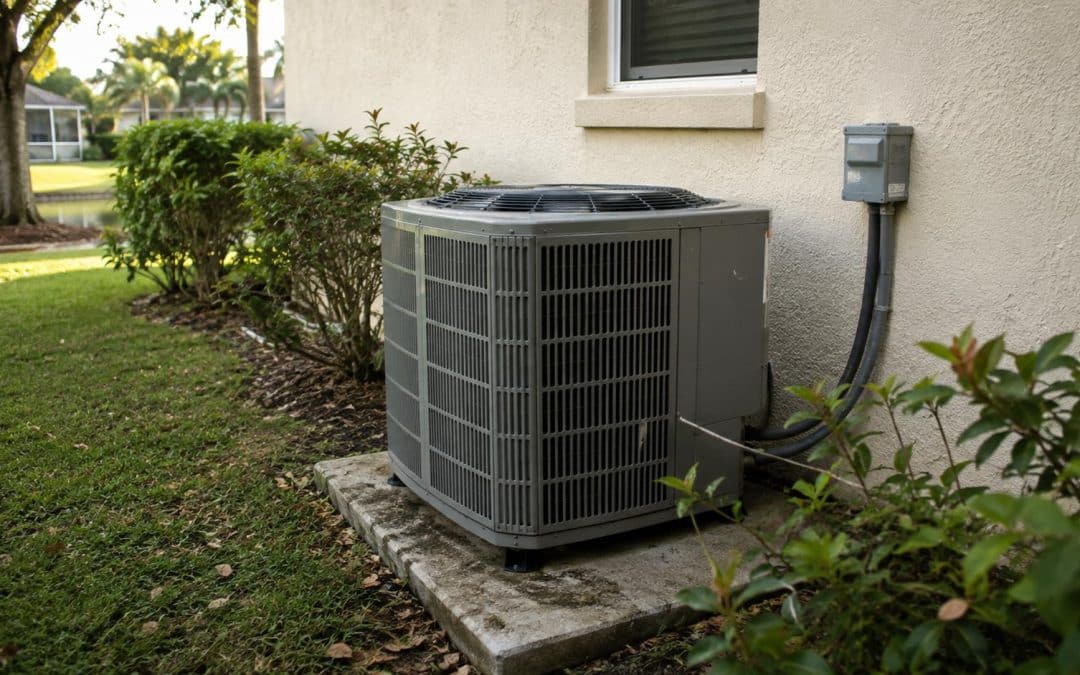
If you’ve lived through even one Jacksonville storm season, you’ve probably asked yourself, “should I turn off my AC during a hurricane?” The short answer is yes. Cutting power to your system before the storm arrives is one of the cheapest ways to prevent the most expensive repair you’ll ever face.
Hurricanes bring power surges. They bring lightning, flooding, and long outages. Your AC sits right in the middle of all of it. The outdoor unit is exposed. The compressor and control board are sensitive. When the grid flickers off and on, your system takes the hit every single time.
Why You Should Turn Off Your AC During a Hurricane
A running AC becomes a target for expensive damage during a Jacksonville storm. Three big threats show up every hurricane season: power surges, lightning strikes, and flooding around the outdoor unit. When your system is powered up during any of them, the damage usually reaches the compressor, control board, or capacitor. Those are the priciest parts to replace.
Power outages are the quiet killer. JEA’s grid holds up well most of the time, but hurricane winds knock down lines across Duval, St. Johns, and Clay counties every season. When power comes back on, it often comes back rough. A surge can move through your system in a fraction of a second and fry the electronics inside. A shut-off unit sits there safely and waits it out.
Lightning is the loud version of the same problem. Jacksonville sits inside one of the most lightning-active regions in the country. A strike a few blocks away can still send a surge through your outdoor unit if it’s running. Turning it off breaks that path completely.
When Should I Turn Off My AC Before the Storm Hits?
Turn off your AC once a hurricane warning is issued for Duval County, or once the first steady bands of rain and wind arrive. That’s usually 6 to 12 hours before landfall.
Some folks like to shut it down as soon as tropical-storm-force winds are in the forecast. That works fine too. The key is to shut it off while your home is still comfortable, not after the power has already dropped once and come back on.
Here’s a trick from long-time Jacksonville homeowners: pre-cool your house before you shut down. Set your thermostat 3 to 5 degrees cooler than usual for a few hours ahead of the storm. Your walls, floors, and furniture soak up the cool. When you finally turn things off, the house stays comfortable longer.
The federal government’s Ready.gov hurricane preparedness page covers the wider prep checklist, from evacuation zones to insurance documents. Your AC shutdown fits inside that same window.
How Do I Safely Shut Down My AC Before the Storm?
Turn it off in two places, not one. The thermostat alone won’t do the job. Follow this order:
- Set your thermostat to OFF, both cooling and fan.
- Head to your electrical panel and flip the breaker for your outdoor unit.
- If your air handler or furnace has its own breaker, flip that one too.
- Snap a photo of the breakers you switched so you remember which ones after the storm passes.
Shutting off at the breaker is what keeps a surge from reaching your compressor. It’s also the step most homeowners skip. Skipping it is why some units come back on after the storm and never work right again.
Should you cover the outdoor unit? Only with a breathable tarp, and only if flying debris is a real risk in your yard. Please don’t wrap it in plastic. If the system somehow turns back on with plastic covering it, the airflow gets choked off and the motor can burn out in minutes.
Can Lightning Really Damage My AC Unit?
Yes, and more often than most people realize. A direct strike is rare, but a nearby strike is common in Jacksonville storms, and either one can wreck your system. The typical damage isn’t fire or an explosion. It’s a fried control board, a blown capacitor, or a compressor that won’t start.
Homes near St. Johns Bluff, Mandarin, and out toward Ponte Vedra see this a lot. Summer storms in those areas fire up and shut down quickly, which means more surges. If you’ve had your AC keep tripping the breaker after a recent storm, that’s often the aftermath of a nearby strike. A whole-house surge protector helps, but it’s not a guarantee. Shutting off at the breaker is still the safest move you can make.
What About Flooding Around the Outdoor Unit?
If floodwater reaches your outdoor condenser, do not turn the system back on. Even a few inches of standing water can force water into the base pan and short out the electrical components inside. Running a wet unit is one of the fastest ways to destroy it.
Folks in low-lying parts of Riverside, Ortega, and the coastal beaches know storm surge is a real concern. Snap a picture of the water level near your unit before it drains. Send it to your insurance company. Then call a technician before you flip that breaker back on.
What Do I Do After the Storm Passes?
Wait until the storm has fully cleared and the power grid is stable. Then take a slow walk around your outdoor unit before touching a breaker. Look for:
- Debris resting on or near the condenser
- Bent fins or damaged fan blades
- Water marks showing how high the flood came up
- Any burning smells or melted plastic
- Downed power lines nearby
If everything looks clean and dry, restore power at the breaker first, then set your thermostat. Give the system a minute or two to boot up. If your AC won’t start, or something smells off, shut it back down and call for help.
Our team handles 24-hour emergency AC service across Jacksonville, the beaches, and every neighborhood in between. We stay open through storm recovery because that’s when the calls come in fastest. If your system stopped working after the last band cleared, we’ve seen every version of it.
Sometimes the damage doesn’t show up right away either. If your AC seemed fine after the storm but stopped working overnight a day or two later, a delayed surge failure is a common culprit.
Why 2026 Storm Damage Costs More Than It Used To
Refrigerant prices roughly doubled this year, and new systems switched to R-454B. What used to be a $400 recharge is now closer to $700 or $800 in the ballpark. A full compressor replacement can run several thousand dollars once labor is factored in. That makes the “should I turn off my AC during a hurricane” decision matter more now than it did a couple of seasons ago.
Shutting down for 6 to 12 hours during a storm costs you nothing. Skipping that step could cost you a full replacement. When you look at it that way, the choice gets pretty simple.
Get Ready Before the Next Storm Reaches Jacksonville
Every storm season, we get calls from neighbors who wish they’d had one more day to prep. If you’re not sure your system is storm-ready, we’re happy to come out and take a look before the winds pick up. A quick inspection can catch surge protection gaps, weak breakers, and drainage issues that turn small storms into big repair bills.
Call Florida Air Flow Heating & Air at (904) 982-9731, or reach out through our contact page. We serve Jacksonville, Atlantic Beach, Neptune Beach, Jacksonville Beach, Ponte Vedra, Nocatee, Orange Park, St. Augustine, and every neighborhood in between. When a storm is in the cone, we’re here to help you get ahead of it.