
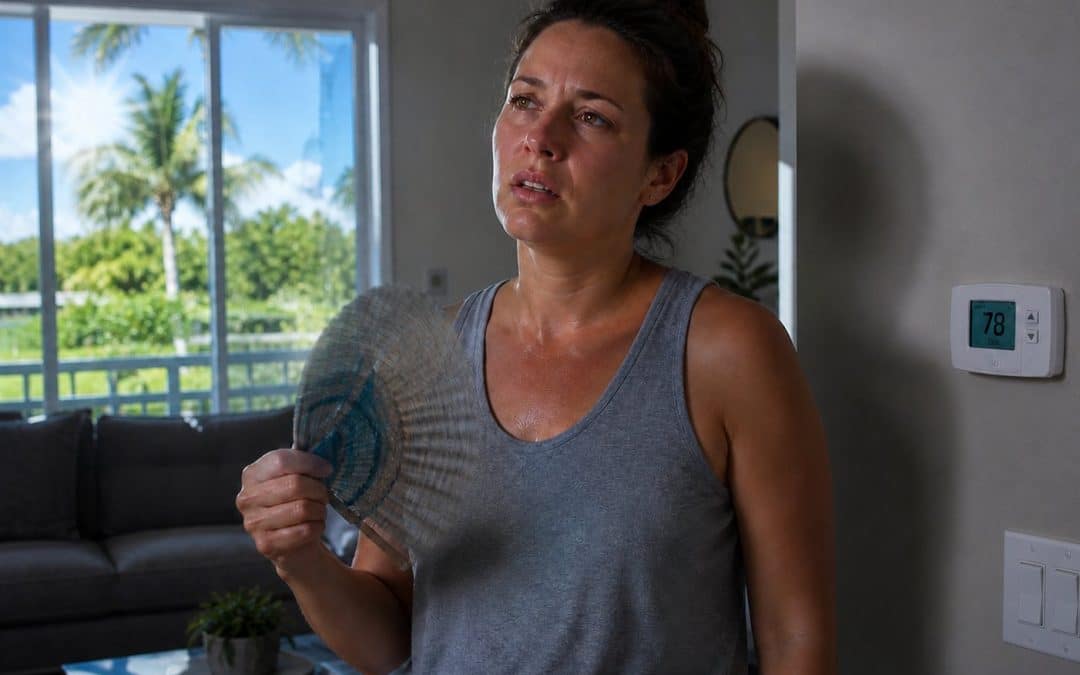
If your house feels so humid with the AC on that you’re still sweating at 72 degrees, your air conditioner is not doing the full job. Your AC has two roles: cooling the air and removing moisture. In Jacksonville, Florida, humidity regularly climbs above 80 percent during summer. Many AC systems can cool a home to the right temperature but still leave the air feeling thick and sticky. Understanding why this happens is the first step to fixing it for good.
How Does an AC Remove Humidity in the First Place?
Your air conditioner pulls warm indoor air across a cold evaporator coil. As that air cools, moisture in it condenses on the coil, just like water droplets form on a cold glass on a hot day. That water drips into a drain pan and exits through the condensate line. The result is cooler, drier air pushed back into your home.
The problem is that this process only works when your system runs long enough to drain meaningful amounts of moisture. In Jacksonville’s heat and humidity, that takes time. When something shortens the cooling cycle, the moisture never leaves. Your home stays sticky even when the temperature feels fine.
The Real Reasons Your Home Still Feels Sticky
Your AC Is Oversized for Your Home
An oversized AC is the most common cause of high indoor humidity in Jacksonville homes, and most homeowners never suspect it. An oversized system cools your home too fast. It hits the set temperature and shuts off before completing a full dehumidification cycle. Then it restarts a few minutes later and does the same thing. This is called short cycling, and it means your home stays at the right temperature but the air never dries out. It takes roughly 15 minutes of continuous runtime for an AC to meaningfully remove humidity. An oversized system rarely runs that long. If your home cools quickly but always feels clammy, this is likely your problem.
Your Thermostat Fan Is Set to ON Instead of AUTO
This is one of the easiest fixes on the list. When your thermostat fan is set to ON, the blower runs constantly, even when the AC is not actively cooling. During the off cycle, the fan blows air across a wet evaporator coil and pushes that moisture right back into your living space. Switch the fan setting to AUTO and the blower only runs during active cooling cycles. This single change often makes a noticeable difference in how the air feels within a day or two. If you want full control over your home’s humidity schedules, a smart thermostat installation gives you that automatically.
Jacksonville’s Humidity Simply Overwhelms a Standard AC
Even a perfectly functioning, properly sized AC system can struggle in Jacksonville during peak summer months. Florida’s relative humidity regularly exceeds 80 percent. During rainy season from June through September, it can climb even higher. When outdoor humidity is this extreme, moisture seeps into your home through tiny gaps around doors, windows, and ductwork. Your AC removes moisture as fast as it can, but outdoor air keeps pushing more in.
This is exactly where a whole-home dehumidifier makes the biggest difference. It actively removes moisture from the air even when the AC is off or running in short cycles.
A Clogged Condensate Drain Line
If water cannot exit through the condensate line, it sits in the drain pan and evaporates right back into your home. Jacksonville’s humidity accelerates algae and biofilm growth inside drain lines, making clogs more common here than in drier climates. A clogged drain line does not just cause humidity problems. It can trigger a float switch that shuts your system down entirely. If your home feels more humid than usual and your system seems to be cycling oddly, check the drain line first. Florida Air Flow includes drain line cleaning in every maintenance visit for exactly this reason. Learn more about why AC drain lines keep clogging in Jacksonville and how to stop it.
Low Refrigerant
Refrigerant is what makes the evaporator coil cold enough to pull moisture from the air. When refrigerant levels drop because of a leak, the coil does not get cold enough to reach the dew point of the air passing over it. The system still cools your home somewhat, but it cannot condense and drain away moisture effectively. The result is cool but clammy air. Low refrigerant is not something that fixes itself. It requires a licensed technician to locate the leak, repair it, and recharge the system. If you suspect a leak, learn the signs in our guide on how to tell if your AC is leaking refrigerant.
Dirty Evaporator Coils or a Clogged Air Filter
Dirt on the evaporator coil acts like insulation, preventing it from getting cold enough to condense moisture efficiently. A clogged air filter restricts airflow across the coil, which has the same effect. Both problems reduce your system’s ability to dehumidify the air and force it to work harder for worse results. Changing your air filter every 30 days during Jacksonville’s heavy cooling season is one of the simplest ways to maintain proper humidity control. A Florida Air Flow maintenance plan includes coil cleaning and filter checks twice a year so these problems never get a chance to build up.
What to Check Before You Call Anyone
Start with these quick checks before calling anyone:
- Switch the thermostat fan from ON to AUTO. This is a free fix that works immediately.
- Check and replace your air filter if it looks gray or clogged.
- Look at the condensate drain line for the exterior PVC pipe near the outdoor unit. If water is not dripping from it during a cooling cycle, the line may be blocked.
- Pick up a digital hygrometer at any hardware store for $10 to $20. If indoor humidity reads above 55 percent, the AC alone is not keeping up. Learn more about what the ideal humidity level should be in a Florida home.
If those steps do not solve the problem, the issue is most likely oversizing, low refrigerant, or dirty coils. All of these require a professional inspection.
When Is a Whole-Home Dehumidifier the Right Answer?
A whole-home dehumidifier is the right answer when the problem is not a broken AC but rather a climate the AC was never designed to handle alone. According to the EPA’s guide on mold and moisture, indoor humidity should stay between 30 and 50 percent. Staying in that range prevents mold growth and maintains healthy air quality. In Jacksonville, hitting that range with an AC alone is often impossible during the hottest and wettest months of the year.
A whole-home dehumidifier installs directly into your existing HVAC system. It removes moisture from the air continuously, even when the AC is not running. It handles the humidity problem independently so the AC can focus on cooling. The result is a home that feels more comfortable at a higher thermostat setting, which typically lowers your energy bill at the same time.
Florida Air Flow installs whole-home dehumidifiers throughout Jacksonville and Northeast Florida. Our indoor air quality services include humidity control solutions sized specifically for your home, not a one-size-fits-all unit from a big box store. If your home consistently feels sticky despite a working AC, a dehumidifier inspection is the fastest way to find out whether one would solve the problem.
Florida Air Flow Helps Jacksonville Homeowners Stop the Sticky
Florida Air Flow serves Jacksonville, Orange Park, Neptune Beach, Atlantic Beach, Ponte Vedra, St. Johns, Nocatee, Fernandina Beach, and surrounding Northeast Florida communities. Our licensed technicians diagnose humidity problems fast. Whether the fix is a thermostat adjustment, a drain line cleaning, a refrigerant recharge, or a whole-home dehumidifier installation, we get it done right. We are available 24/7 with same-day scheduling.
If your house feels so humid with the AC on that you cannot get comfortable, do not keep turning the thermostat down and hoping it gets better. Contact Florida Air Flow today to schedule an inspection and find out exactly what is keeping your home from feeling the way it should.